Press Tonnage and Circumscribing Circle: Why Not Every Factory Can Run Every Profile
The maximum profile size a factory can produce is governed by the circumscribing circle diameter of the container on its extrusion press, not by the press tonnage alone. A 2500-ton press with a 10-inch container can still be limited to profiles under roughly 250mm in circumscribing circle diameter, while a smaller-tonnage press with a larger container may actually handle a wider profile at lower wall thickness. When a custom profile design is sent out for quotation, matching the circumscribing circle to a factory's actual container size, rather than just its advertised tonnage, avoids a situation where a design is quoted and tooled before anyone realizes the profile physically cannot pass through the equipment on hand.
Multi-Cavity Dies and Their Effect on Section Complexity
Running two or more identical profiles through a single die in one extrusion cycle increases output per press cycle, but it also constrains how complex each cavity can be. Multi-cavity dies distribute the available extrusion pressure across all cavities, so a profile that would extrude cleanly through a single-cavity die may show incomplete filling or uneven wall thickness when run as one of four cavities in the same die. Profiles with thin walls or asymmetric mass distribution are generally better suited to single or dual-cavity tooling, while simpler, more symmetric shapes take better advantage of higher cavity counts.
Straightness and Twist Correction After Extrusion
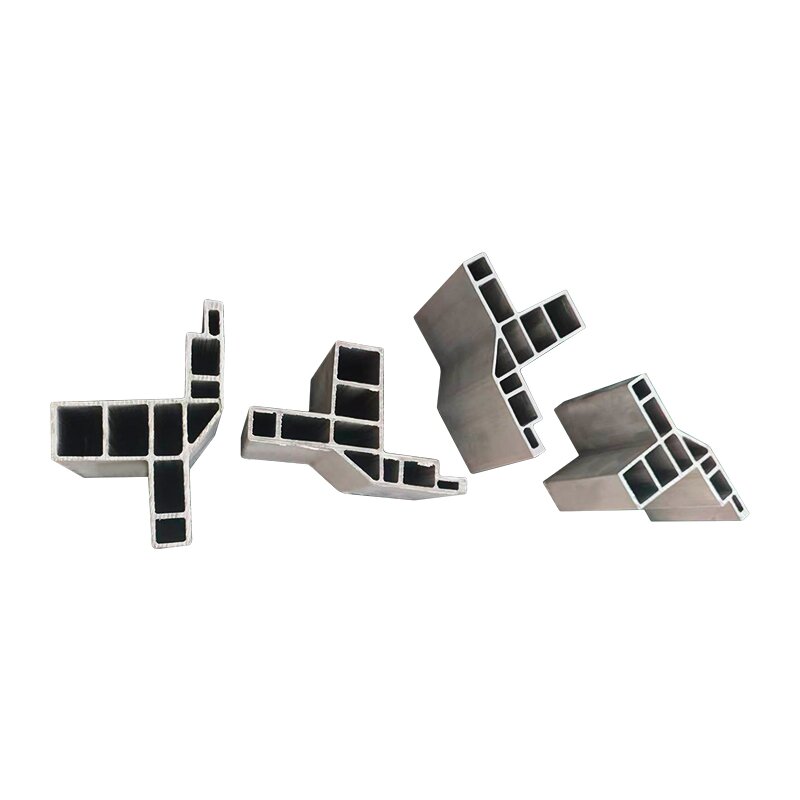
Freshly extruded profiles come off the press hot and are pulled through a stretcher to correct bow and twist while the metal is still workable. The amount of stretch applied, typically a small percentage of the profile's overall length, has to be calculated based on the specific alloy and cross-section, because over-stretching thins the wall sections unevenly while under-stretching leaves residual bow that shows up later during machining or assembly. Profiles with an asymmetric cross-section, such as an L-shape or a profile with a heavy flange on one side, are particularly prone to twist during cooling and often need a slightly different stretch ratio than a symmetric profile of similar size to straighten correctly.
- Twist is measured as the angular deviation along the profile's length and is usually specified as a maximum number of degrees per meter on the drawing.
- Profiles that will be cut into short lengths for machining are more forgiving of minor bow than long profiles used as structural members, since bow becomes proportionally less significant as cut length decreases.
- Re-straightening a profile after it has already been aged to full hardness is far less effective than correcting it during the stretcher stage, since the material has lost much of the ductility needed for cold correction.
The temper a custom profile is aged to affects both its mechanical properties and how it responds to any secondary bending or machining. The table below outlines common aging practices for heat-treatable 6000-series profiles and where each is typically applied.
| Temper |
Process |
Relative Strength |
Typical Use |
| T4 |
Solution heat treated, naturally aged |
Lower |
Profiles requiring post-extrusion bending or forming |
| T5 |
Cooled from extrusion temperature, artificially aged |
Medium-high |
Most standard architectural and industrial profiles |
| T6 |
Solution heat treated, artificially aged |
Highest |
Structural components under higher load |
Choosing T5 when T4 was actually needed for a downstream bending operation is a common specification error, since the profile arrives too hard to bend without cracking. Confirming the intended secondary processing before finalizing the temper callout on the purchase order avoids this mismatch.
Die Cost Amortization and Minimum Order Quantities
A custom extrusion die represents a one-time tooling cost that most factories either charge upfront or amortize into the unit price across an agreed order volume. The amortization approach generally works better for buyers who expect repeat orders of the same profile, since the die remains factory property but is available for future runs without a second tooling charge, while a low first-order volume paired with amortized die cost can result in a per-kilogram price that looks artificially high compared to a stock profile. Buyers evaluating quotes for a new custom shape should ask specifically whether the quoted price includes full die cost recovery in the first order or spreads it across a projected annual volume, since this single variable can account for a large part of the price difference between two otherwise similar quotes.
Surface Protection Films and Their Compatibility with Later Processing
Protective PE film applied to extruded profiles before shipment is chosen based on the finish underneath it and the environment the profile will pass through before installation. Film with an adhesive rated for short-term indoor use can leave a sticky residue if the profile sits in outdoor storage or direct sunlight for an extended period before the film is removed, since UV exposure and heat both accelerate adhesive breakdown. Profiles that will undergo further CNC machining or anodizing after extrusion generally need film that can be cleanly removed without leaving residue that would interfere with anodizing uptake or machining coolant flow, which is a different film specification than one meant only to protect a finished part during transport and installation.


 English
 Español
 عربى
عربى